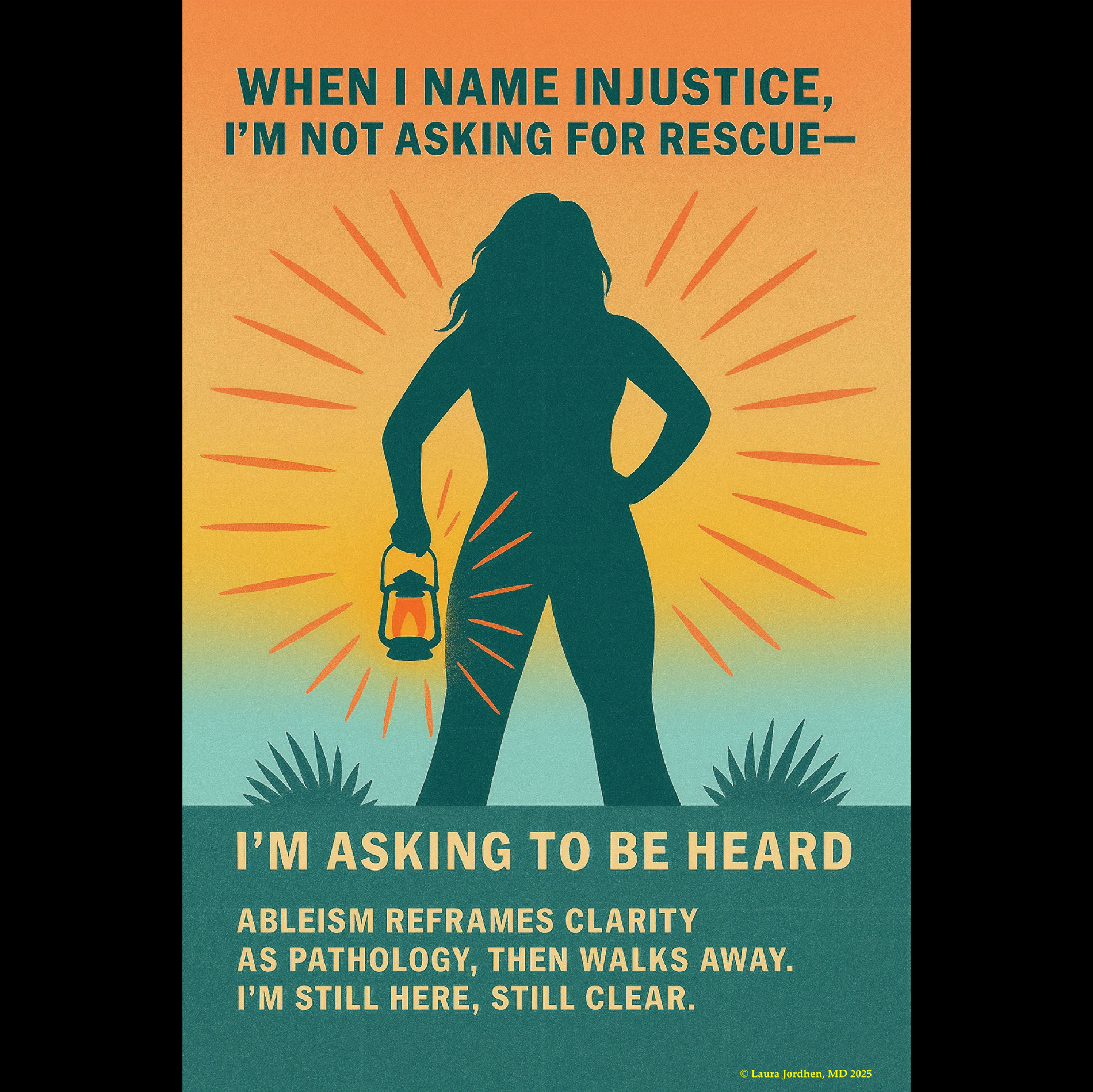
You name the harm (“this feels unjust.”) They reframe it as pathology (“you need help.”) Then they withdraw (“but I can’t help you, so please stop.”)
Does this sound familiar?
When I was living with significant depression, people sometimes made decisions about me, not with me. I expressed my dismay, but my words were obscured by my illness. This was especially painful when coming from people in the healing professions.
When you struggle with the symptoms of a significant illness, it’s hard to speak with clarity and equanimity. The message you are trying to send comes in some difficult packaging, and not everyone wants to open it. It is common to feel unheard and dismissed. You don’t deserve it.
I also have my biases and blind spots. Self-awareness is a skill that helps me move beyond them. I also ask you to reflect: when a patient, a colleague, a direct report seems too “sensitive,” “unprofessional” or “hormonal,” is it possible you are avoiding the discomfort of examining your own biases and taking accountability for them?
I’ve been thinking about my Why. As a physician, I am in a profession that draws altruistic people—myself included.
But I’ve become jaded. I’ve seen altruism exploited by employers who know we’ll always come through for the patients, even to our own detriment. Burnout, moral injury, and depression are rampant in my field. We’re not attracting or retaining enough physicians to meet today’s needs, let alone those of an aging population. Even empathy is getting a bad rap these days.
The personal toll can be devastating. I still have nightmares about my last job, though I left it more than a year ago. And the outcomes can be much worse. Physicians, especially female physicians, have higher suicide rates than the general population.
So why be of service? The idea seems like a truism, but really—what is the logic in this?
First, it’s important to think about what being of service really means. Physicians are trained to fix. This is fundamental, essential, and necessary. Yet cures are rare. Tying the idea of service to the outcome of our effort is, I believe, where we get the misnomer “compassion fatigue.” Compassion is empathy plus a desire to act—but the most powerful action may be brave, nonjudgmental presence.
We learn in the helping professions to fill our own cups before pouring them out for others. But if the receiver has a cracked cup, no amount of pouring will fill it. That’s a tough lesson. I felt a terrible loneliness in realizing that no amount of praise or validation would stay in my broken cup until I found the self-compassion and strength to prepare it to hold the love of others. In my practice, being brave enough to sit with a patient’s pain—without hiding behind advice they’ve heard umpteen times—can help them find that courage too.
In this way, serving from our wholeness, being mindful of what is needed and what is not, is uplifting. It is even—as His Holiness the Dalai Lama puts it—wise selfishness. Helping others and being kind activates dopamine for the giver. It strengthens our support networks for when we need help. It creates a happier environment to live and work in. It deposits karma in the great bank of life—or eases the passage to eternal joy, depending on your worldview.
I hope we will evolve toward a medical culture and economic model where my colleagues can rediscover their altruistic drive as a source of healing and restoration—no matter how or where they practice. In this world, service is not sacrifice, but sustenance. We become living models for our patients, showing how brokenness, when met with self-compassion, can be transformed—veined with gold, shining through.